You walk away from a fender bender, exchange insurance information, and assume you can skip calling 911. Under Illinois law, that decision can cost you. Drivers must report any crash that involves injury, death, or property damage over $1,500 under 625 ILCS 5/11-401, and insurers treat the absence of a police report as a red flag the moment a claim crosses their desk.
When officers do not respond to the scene, Illinois drivers can still document the crash by completing the Illinois Motorist Report (Form SR-1) and submitting it to the Illinois Department of Transportation. Skipping that step gives the at-fault driver’s insurer an easy reason to deny or undervalue your claim, and it can leave you on the hook for hidden vehicle damage and delayed-onset injuries.
If you were in a Chicago-area car accident and did not call the police, our Chicago car accident lawyers can review what you have and walk you through your options.
Call Staver Accident Injury Lawyers, P.C. at (312) 236-2900 to schedule a free, confidential consultation.
After a minor accident, you may decide that since your car is drivable, it is fine. But, unless you’re a mechanic and you gave your car a thorough examination, you don’t really know for sure. What if, for instance, the frame is cracked? You don’t know because you can’t see it.
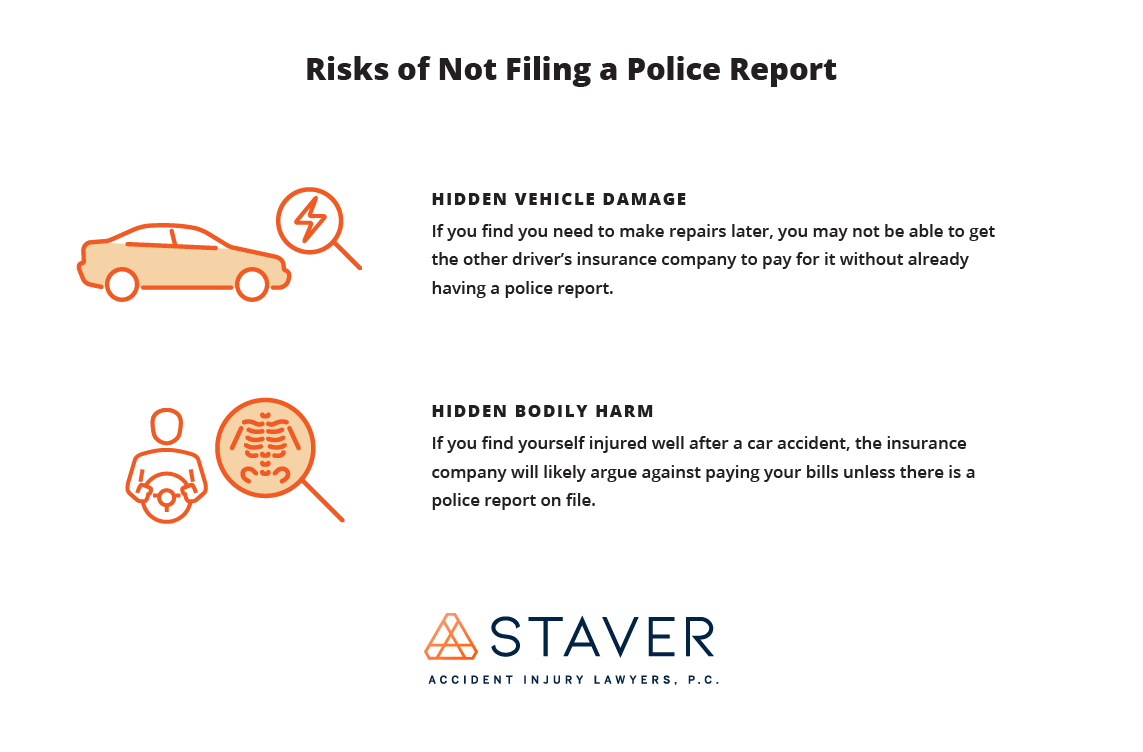
It’s possible to have minor dents or dings turn into bigger problems down the road. If you find you need to make repairs later, you may not be able to get the other driver’s insurance company to pay for it. Instead, they will likely make the argument that you’re trying to be reimbursed for car problems that existed before the accident. Without a police report or any proof of the accident, you may not be able to recover proper compensation.
Similarly, you may feel fine right after the crash, but later on, you begin to notice pain in your back or neck. The force of even a minor rear-end accident can be enough to jerk your neck, which could result in injury to areas like your neck or spine. Again, the insurance company will probably argue against paying your bills, since you didn’t get medical treatment right away or bother to file a police report.
Learn How to File a Police Report >>
You are required by law to file a police report, particularly in certain circumstances. This includes if one car was considerably damaged or one or more people were hurt or killed. Not doing so could result in a fine or even jail time.
Many counties don’t send police to the scene of an accident when the damage is minor and the drivers are uninjured. But, that doesn’t mean you can’t still file a report. You can go to the station, or call the police after a car accident. Some precincts may allow you to file online as well. No matter what method you choose, it’s important that you do it right away because you only have a 10-day window to report the accident.
“When should I call the police” is rarely a one-size question. The right move depends on where the crash happened, who got hurt, and whether the other driver stuck around. Three scenarios cover most of what Chicago-area drivers run into.
A low-speed bump in a Jewel-Osco lot or a Loop parking garage can feel too minor to involve police. Illinois still requires reporting the crash if either driver is hurt or the damage to any vehicle or property tops $1,500. Bumpers and quarter panels routinely cost more than that to replace, and parking lot crashes often involve disputed fault: who had the right of way at the row, who was reversing, who was on a phone. Without an officer’s incident number or your own SR-1 filing, the other driver’s insurer can simply tell its policyholder to deny everything. Photograph both vehicles and the lot, get the other driver’s license and insurance details, and call the local non-emergency line so an officer can either respond or generate a report number.
A crash on I-90, I-94, the Edens, or any Illinois interstate that produces injury triggers a clear duty under 625 ILCS 5/11-401. You must stop, render reasonable assistance, exchange information, and notify police. Failing to stop or report after an injury crash is a felony in Illinois, separate from anything the at-fault driver did to cause the wreck. Even a “minor” rear-end can produce neck and back injuries that show up days later. The crash report Illinois State Police or the local department generates is what every adjuster, judge, and Cook County jury will use to anchor the timeline.
If the other driver flees, your reporting duties do not pause. Illinois treats hit-and-run as a serious offense, but it also requires the remaining driver, you, to report the crash to police promptly. Note the location, time, direction of travel, and any partial plate, vehicle make, model, or color you observed. Filing right away is also how you preserve an uninsured-motorist claim against your own carrier; most policies require notice within a tight window, sometimes 24 to 72 hours. Our team handles Chicago hit-and-run cases and can deal with the insurer while police investigate.
If you’ve recently been in a minor accident and you’re not sure what you need to do, you should contact a lawyer for advice. Our attorneys at Staver Accident Injury Lawyers, P.C. help motorists no matter how big or small the accident. The important part is to make sure you’re covered against any future incidents. Our car accident attorneys serve clients throughout the Chicago area, including Aurora, Elgin, Hinsdale, Joliet, Naperville, and Waukegan. To schedule a free consultation, contact us at (312) 236-2900 right away.
When you’re fighting for maximum compensation, we know what it takes to get it.